
Duet Design Group specified Martin Pierce’s Orchid Spray hardware for a custom interior barn door as part of a high-rise residential remodel in Colorado. When asked why they made this selection, the firm explained:
“The piece was selected for its sculptural quality and refined detailing, adding a sense of softness and craftsmanship to a clean, architectural moment within the home.”
That observation perfectly captures the beauty and craftsmanship that emerge when an artist employs the lost-wax process to create functional art. At the start of 2026, we felt it was worth revisiting this ancient technique to understand how and why it remains the foundation of truly exceptional architectural hardware.
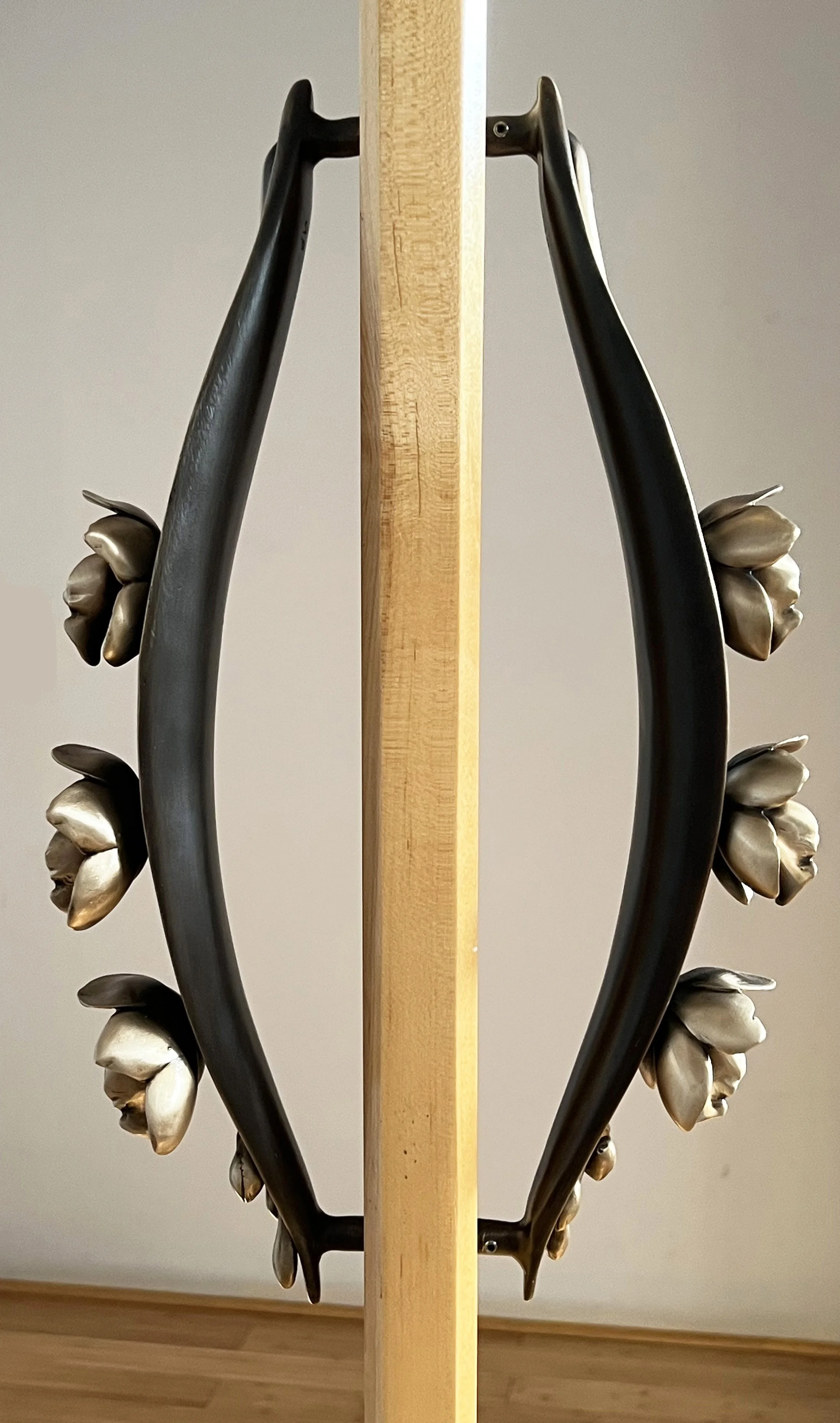
More than hardware, the orchid spray becomes functional art—bridging nature, architecture, and craftsmanship.
Lost Wax - Investment Casting
The terms lost wax and investment casting describe a process in which wax replicas of an original pattern are burned out of a hardened shell, leaving a cavity that is then “invested” with molten bronze or another alloy.
The Orchid Spray began as five individual patterns, each hand-carved by Martin Pierce in wood. Once carved, the surfaces were carefully primed to create non-porous, easily removable originals. As a trained wood carver, Martin uses a wide range of chisels and tools to achieve the fine botanical detailing visible in the finished bronze.
From these wooden patterns, soft rubber molds were created by pouring and curing flexible rubber over each form. The rubber captures every contour of the carving. Once cured, the mold is peeled away from the pattern, leaving a void that is later filled with melted wax.
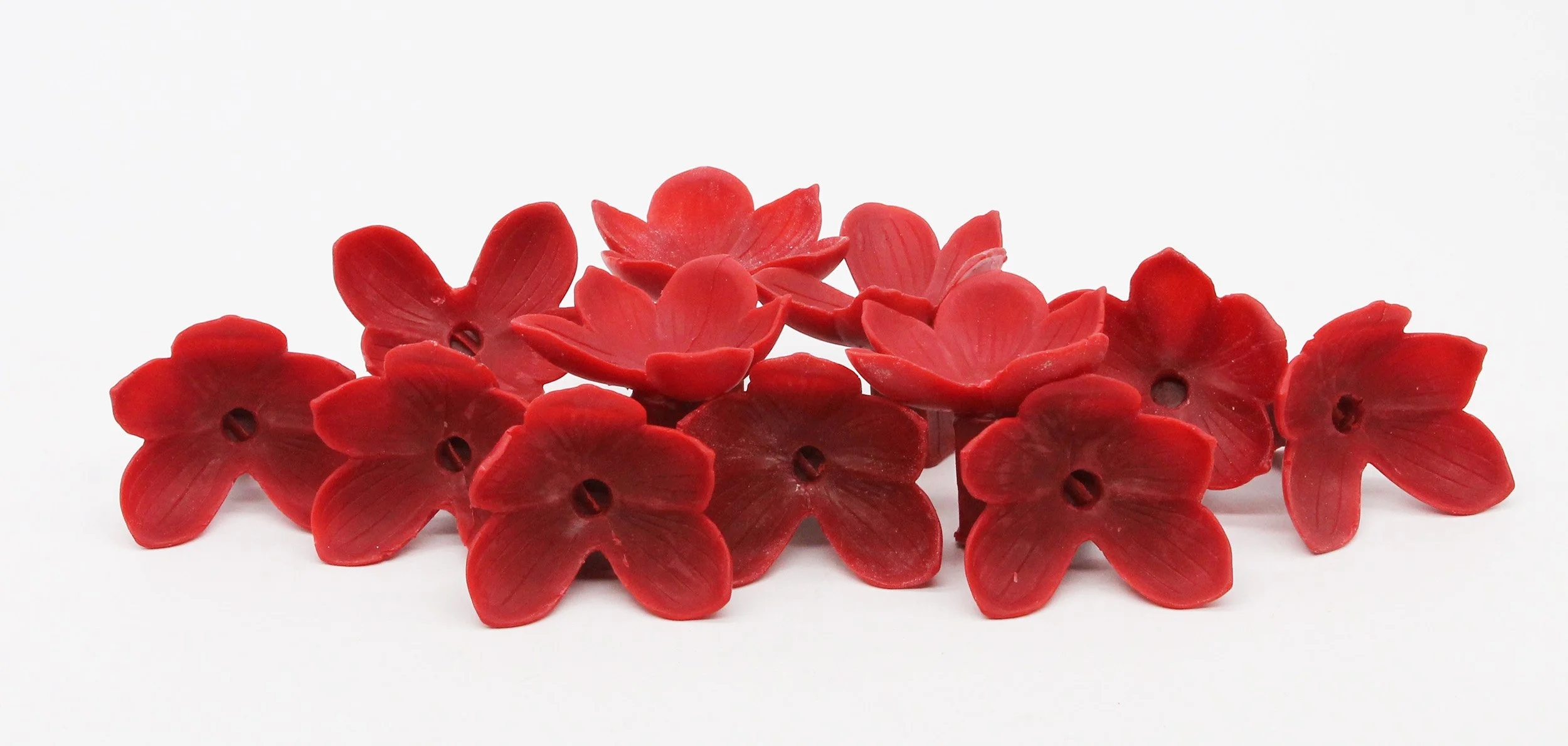
The orchid spray door pull at the wax stage, where each botanical detail is refined by hand before casting in bronze.
Trees, gates, and sprues
The design of the mold — and the eventual flow of molten metal — determines where the “gate” to each wax piece is created. For smaller elements, multiple waxes are joined onto a central sprue, forming what is known as a wax tree.
During casting, the bronze flows through the wax tree and into each gated piece. The placement of the gates is established at the mold-making stage, while the number of pieces attached to each sprue depends on how far the bronze can travel before it loses heat and momentum.
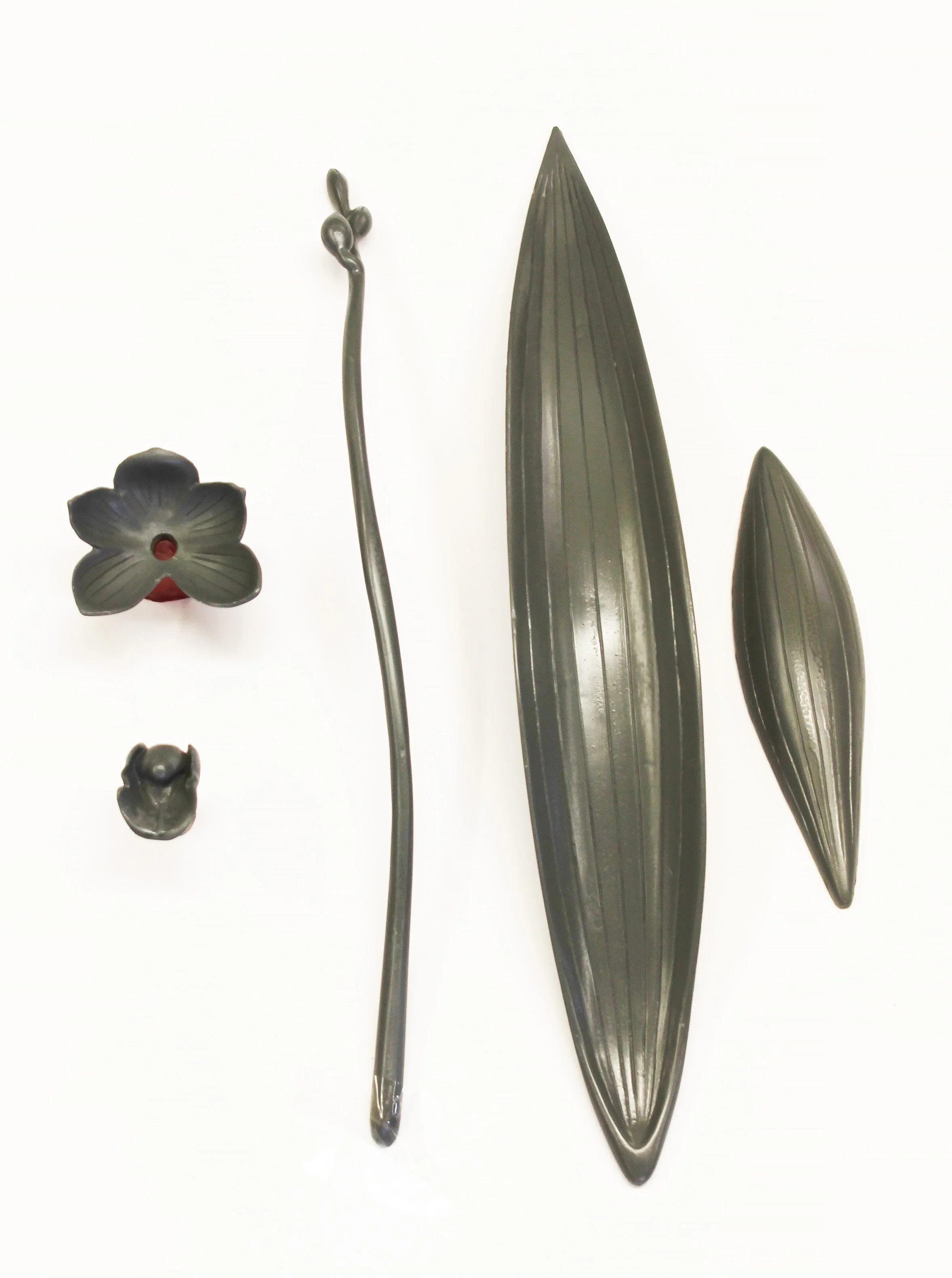
Original sculpted master patterns from which the bronze orchid spray door pulls are cast, preserving the organic form through every generation.
Shelling and Autoclave
Before bronze can be poured, the wax tree — complete with sprues and gated waxes — is encased in a rigid mold through a process known as shelling. The assembly is repeatedly dipped into ceramic slurry and coated with sand. This layering process can take several days, as each coat must fully dry before the next is applied. The result is a shell thick and strong enough to withstand the weight and temperature of molten bronze.
Before kiln firing, most of the wax is removed rapidly using high-pressure steam inside an autoclave. Because wax and ceramic have different melting points, the wax is flash-melted and drains from the shell through a large funnel. If this step were skipped and wax removal were left entirely to kiln firing, the expanding wax would generate internal pressure sufficient to crack the shell.